

8 Communication Mistakes That Make You Sound Less Credible at Work
The communication mistakes that make you sound less credible at work are apologising for asking, hedging your recommendations, burying your request, and letting AI write the messages people expect to come from you.
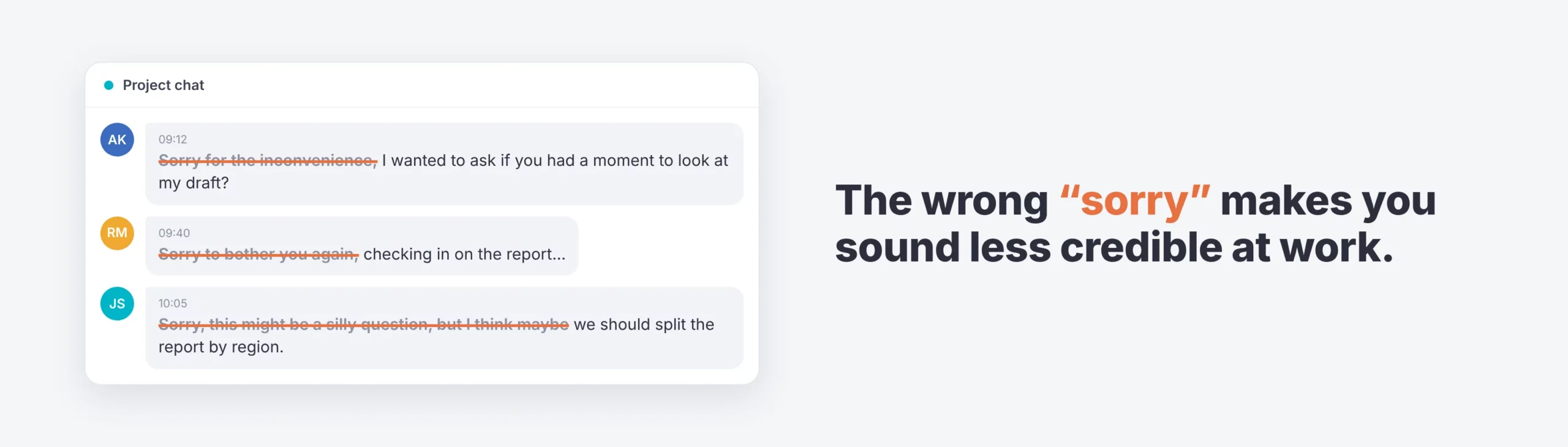
"I'm sorry for the inconvenience."
That's how many of the messages I receive begin. It comes in emails, in Teams chats, and out loud in class, before the person has even asked their question.
I teach in a master's programme at a university in Germany. My students are not beginners. Most come back to study after years of professional work. Yet they apologise before they ask, they hedge before they recommend, and they explain for three paragraphs before they get to the point.
What communication mistakes make you sound less credible at work?
The biggest mistakes are apologising for asking, hedging, over-justifying, burying your request, bringing problems without a proposal, presenting facts without a story, writing unclearly, and staying silent where decisions are made.
- You apologise for taking up space. "Sorry to bother you" tells the reader your request is a burden before they've read it.
- You hedge. "I think maybe we could possibly..." is yet another way you shrink yourself. Wharton professor Jonah Berger explains that hedges like "I believe" and "kind of" signal uncertainty and weaken your impact. "Just" does the same: "I just wanted to ask" sounds smaller than "I wanted to ask".
- You over-justify. Explaining why you deserve to ask is yet another way you shrink yourself. Ask, and give context only if it changes the answer.
- You bury the ask. The request sits in paragraph four. Put it in the first line.
- You bring a problem without a proposal. "We have an issue with the data pipeline" hands your problem to your manager. "The pipeline is two days late. I propose X. Can you approve it today?" makes you the person who solves it.
- You present facts without a story. People forget numbers and remember what happened. Tell them who had the problem, what you did and what changed.
- You write long and unclear. If your message needs a second read, it won't get one.
- You stay silent where decisions are made. If executives outside your team don't know your work, your work doesn't speak for you. Silence is the final way you shrink yourself. Start by learning to talk about your work in business terms.
What should you say instead of "sorry" at work?
Replace apologies for your own presence with thanks, a direct request, or a recommendation.
| Don't say | Say |
|---|---|
| "Sorry for the delay." | "Thank you for your patience." |
| "Sorry, but can I add something?" | "I'd like to add a different perspective." |
| "Sorry, my mistake." | "Thank you for catching that. I'll fix it by Friday." |
| "Sorry to bother you, but..." | "Could you review this by Thursday?" |
| "I think maybe we could..." | "I recommend..." |
| "I just wanted to ask..." | "I wanted to ask..." |
| "I'm just working on this analysis." | "I'm working on this analysis." |
| "Just checking in." | "Can you confirm X by Friday?" |
| "I'll try to send it." | "I'll send it by Friday." |
| "Please advise." | "What do you recommend?" |
Is apologising always a mistake?
No. An apology that shows care for the other person builds trust, while an apology for your own presence takes trust away.
In a field study by researchers from Harvard and Wharton, a stranger asked people at a train station to borrow their phone on a rainy day. When he first said "I'm so sorry about the rain!", 47% handed over their phone. Without the apology, only 9% did (Brooks, Dai and Schweitzer).
Notice the difference. "Sorry about the rain" is about them. "Sorry to bother you" is about you being a burden.
Should you use AI to write personal messages?
No. Use AI for your documents and analysis, but write to people in your own words.
I've seen people ask AI: "My teacher is asking why I'm late, help me draft a respectful reply." Two sentences of your own would have done better.
Research backs this up. In a study of more than 1,100 professionals published in the International Journal of Business Communication, 83% saw a manager's message as sincere when it was written with little AI help. With heavy AI help, that dropped to between 40% and 52% (Coman and Cardon).
People can tell. When they can, they trust you less.
So the next time you start typing "I'm sorry for the inconvenience", pause. Ask yourself: what do I actually want, and can I say it in the first line?
Next Step Forward
Every Lumen course trains how you speak and write, not only what you know. You present your findings to a business audience. You write up each portfolio project in business terms. You record videos of yourself presenting. And you get 1:1 feedback on your messages, your CV and your posts.
If you want feedback on how you come across, feel free to reach out for a free 30-minute consultation. Drop us an email at lumen@digitalmunich.com and we'll get back to you directly.

Dr. Humera Noor
Founder, Lumen | CTO, Digital Munich
Dr. Humera believes that magic happens beyond the comfort zone and consistently ventures into uncharted territories. She brings over 25 years of expertise in artificial intelligence, machine learning, computer vision, and data science. She holds the distinction of being the first female Ph.D. degree holder of the century-old NED University of Engg. & Technology. Her career spans both academia and industry, where she has consistently pushed technological boundaries. Notably, Dr. Humera led a team that pioneered the commercial implementation of machine learning for automating online ad detection, a groundbreaking achievement in the ad-filtering industry.
In addition to her innovative work, Dr. Minhas is deeply committed to education, lecturing at Universities & institutes, conducting webinars & workshops, presenting keynotes and participating in panels, which showcases her dedication to empower the next generation of tech professionals.
Dr. Humera's multifaceted career exemplifies her mission to help individuals become the best version of themselves, living by the principle: "Give a man a fish and you feed him for a day. Teach a man to fish and you feed him for a lifetime."
Dr. Humera can be reached at her LinkedIn.