

How Do You Develop Business Acumen as an Engineer or Data Professional?
You develop business acumen by asking why before you start, translating every result into revenue or cost, and learning the business metrics your work moves.

If you work in tech, you have probably heard this advice:
- "Talk in terms of business impact."
- "Don't list your responsibilities on your CV. Show your impact."
- "Engineering is a cost centre, so prove your worth in business terms."
Employers agree. Cisco surveyed 600 IT and business decision-makers for its Next-Generation IT Talent Strategies report. They ranked business acumen as the top skills gap, ahead of critical thinking, problem solving, and technical skills like cloud and security.
The gap is still open. PMI's Pulse of the Profession 2025 surveyed 2,841 project professionals and found that only 18% have high business acumen.
All this advice is important and given in good faith. But it misses an important point: how can engineers develop business acumen?
That is the exact question one of my students asked me recently: how do I learn to think and talk in business terms?
Business acumen is one of the seven skills you need to thrive in 2027. This blog answers how to build it. But first, why it matters more than most engineers think.
Why is business acumen important for engineers?
Engineering is typically seen as a cost centre, so engineers need to show, in business terms, how their work adds to the revenue or reduces the costs - because when a company cuts or approves budget, that is the question that decides.
A cost centre is needed to run the business, but it does not bring in revenue directly.
Gergely Orosz, author of The Pragmatic Engineer, explains the difference between profit centres and cost centres. He describes how being tied to revenue made one team's position "more safe, even during large layoffs."
Being technical does not protect a team either. In October 2025, Meta cut around 600 roles in its AI unit, including its research lab FAIR. In February 2026, Salesforce cut nearly 1,000 roles, including teams in data analytics and its Agentforce AI product.
I have been part of strategising and executing layoffs and re-orgs. I know first-hand that the decision relies on whether a person or a team adds to the costs or adds to the revenue.
The same goes for hiring. You get budget for a new hire only if you can prove the value of that role in business terms. If you don't speak the language of business, you can't ask for budget or more resources for your project.
Even data leaders find this hard. In a Gartner survey of 504 data and analytics leaders, only 22% said their organisations define, track and communicate business impact metrics for most of their data and AI use cases.
How do you develop business acumen, even without work experience?
Start every task with why, translate every result into revenue or cost, and learn the business metrics your work moves.
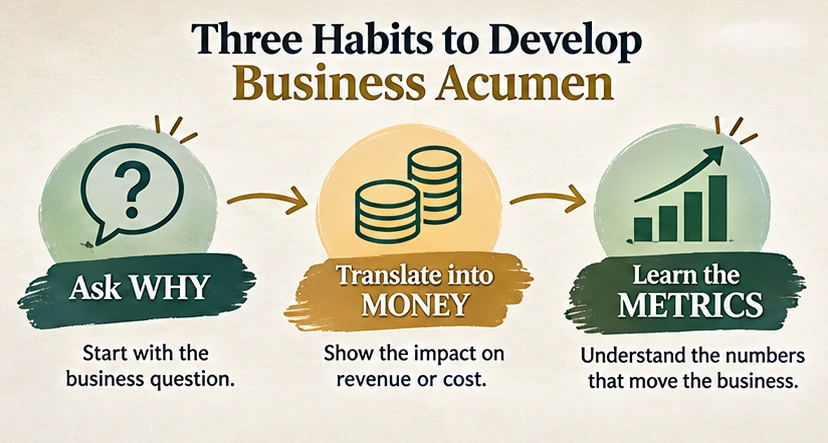
Business acumen is easier to learn in a real job. I learned it in all my jobs by asking why I do what I do. But these three habits work for newbies and career changers too.
1. Ask "why" before you start
Before you open a dataset, ask: why am I solving this problem, and what will be the impact? If the answer is not connected to a business metric, the exercise may be futile.
Put the business question first and the tool second. This is how we teach in our Data Analytics Program.
For example, in our Excel for Data Analytics module, we use Walmart's sales data. We first ask: what is the sales risk across different stores? Only then do we calculate the standard deviation and variance. Calculating a standard deviation is easy. Knowing that it tells you about sales and inventory risk is what makes it a business case.
We do the same in every module, from Python to SQL to Tableau. Every tool is taught in the context of a real company's business question.
2. Translate every result into money

Business acumen boils down to money. Whatever you are doing, ask how it increases revenue or reduces costs.
Here is a test. Your model performance increased from 90% to 95%, and it took three engineers a month to get this gain. What impact does it have on the business? Is it getting more customers? Is it helping generate more revenue? Is it reducing costs?
If the answer to all of these questions is "no" or "I don't know", then why did we spend (or rather waste) a month of three engineers' time on it?
Make this a habit for every result you share. Add one line that says what it means in euros, customers or hours saved.
3. Learn the core business metrics
You can't connect your work to the business if you don't know what the business measures. Start with these, and ask which ones your work moves.
| Metric | How your work can move it |
|---|---|
| Revenue | A recommendation model that raises the average order value |
| Cost | Automating a manual report that takes an analyst a day every week |
| Customer count | Finding the sign-up step where most users drop out |
| Conversion rate (visitors who buy) | Testing which landing page sells better |
| Churn (customers who leave) | Predicting which customers are about to cancel |
| Time to X (deliver, resolve, hire) | Routing support tickets automatically, so they are resolved faster |
| Latency | Speeding up a slow query or model, so users don't give up |
Then look at your own projects. For each one, name the metric it moves. If you can't name one, go back to habit 1 and ask why.
How do you show business impact on your CV?
Replace each responsibility with what changed for the business because of your work.
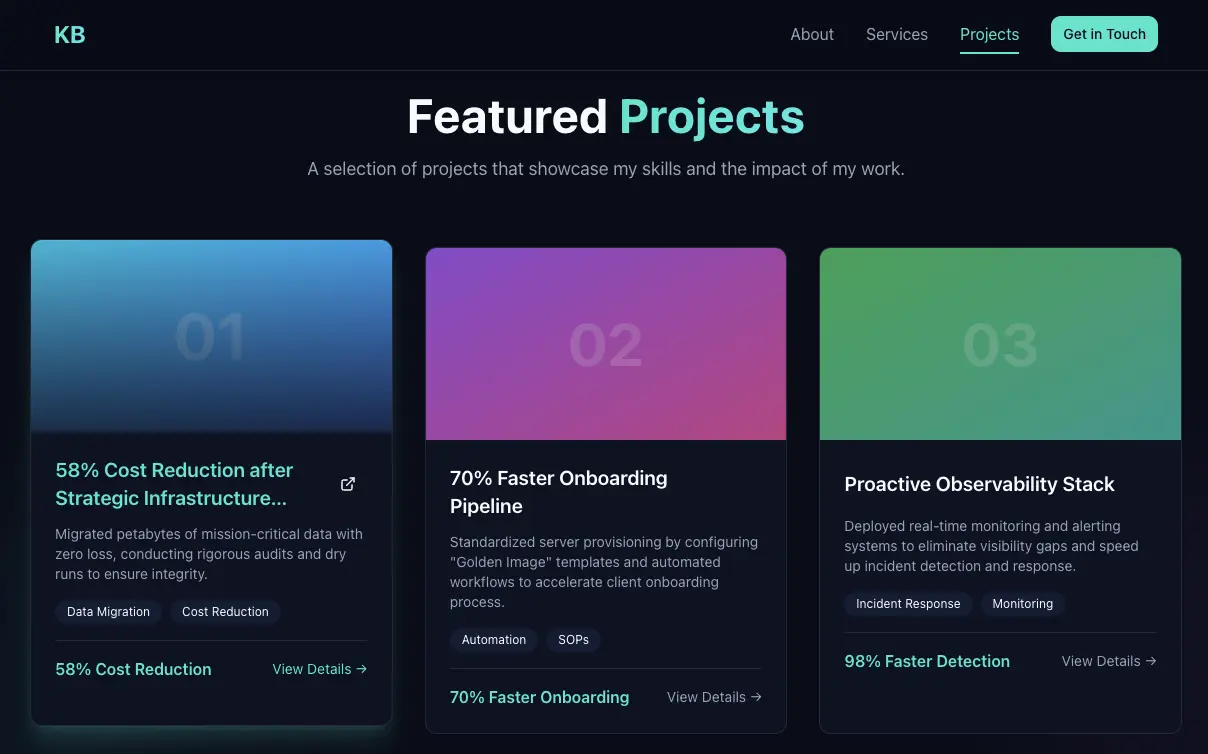
A responsibility tells an employer what you were supposed to do. Impact tells them what happened because you did it.
- Responsibility: "Built dashboards for the sales team."
- Impact: "Built a sales dashboard that replaced a weekly manual report, saving the team four hours every week."
The same rule applies to your portfolio. Kwasi had built strong projects, but the business impact wasn't visible. Two weeks in our Job Search Accelerator fixed that. In his words: "I got many recruiters approaching me after I polished my portfolio." See Kwasi's portfolio.
So if you're tempted to show off your model performance gain from 90% to 95%, pause and ask yourself: so what?
Next Step Forward
Our Data Analytics Program is built around that question. Every module starts with a real company's business problem, and the tools come second. It is self-paced, so you can start when you are ready.
If you have already built projects but don't know how to present them in business terms, our Job Search Accelerator helps you turn them into a portfolio and CV that show your impact.
If you are not sure where to start, feel free to reach out for a free 30-minute consultation. Drop us an email at lumen@digitalmunich.com and we'll get back to you directly.

Dr. Humera Noor
Founder, Lumen | CTO, Digital Munich
Dr. Humera believes that magic happens beyond the comfort zone and consistently ventures into unchartered territories. She brings over 25 years of expertise in artificial intelligence, machine learning, computer vision, and data science. She holds the distinction of being the first female Ph.D. degree holder of the century-old NED University of Engg. & Technology. Her career spans both academia and industry, where she has consistently pushed technological boundaries. Notably, Dr. Humera led a team that pioneered the commercial implementation of machine learning for automating online ad detection, a groundbreaking achievement in the ad-filtering industry.
In addition to her innovative work, Dr. Minhas is deeply committed to education, lecturing at Universities & institutes, conducting webinars & workshops, presenting keynotes and participating in panels, which showcases her dedication to empower the next generation of tech professionals.
Dr. Humera's multifaceted career exemplifies her mission to help individuals become the best version of themselves, living by the principle: "Give a man a fish and you feed him for a day. Teach a man to fish and you feed him for a lifetime."
Dr. Humera can be reached at her LinkedIn.