

Will AI Take My Job?
A Reality Check for Aspiring Data Professionals
Raise your hand if you have heard some version of this sentence in the last year:
“AI is taking over. Data jobs are disappearing.”
If you are new to the data field, you’ve probably felt that quiet worry in the back of your mind and it’s understandable, the noise is loud, the headlines are dramatic, and fear travels faster than facts.
But when we step away from the hype and look at what’s actually happening, a very different story emerges. Whether you’re stepping into Data Analytics, Data Science or ML Engineering the same fear and question shows up again and again. Will AI makes these roles obsolete?
Let’s walk through it…
How We Got Here: The Real Shift in the Data Job Market
Over the last decade, data exploded much faster than organizations knew what to do with it.
From the early “big data boom” to the democratization of learning through online bootcamps and certificates, data related jobs have become one of the most accessible technical careers on the planet.
Which means two things happened simultaneously:
- Demand for data professionals kept rising
- More people than ever entered the field
So today’s job market isn’t collapsing, it’s crowded, and that’s a very different problem to solve.
The Big Question: Is AI Coming for Data Roles?
Many believe AI will replace analysts entirely, but if you zoom in, you’ll notice something important:
AI is replacing tasks, not data professionals.
Routine, repetitive, rule-based work is being automated, but analytical thinking, contextual judgment, and business understanding are not going anywhere.
Because working in data isn’t just:
“clean the data → run the query → generate the chart.”
It is:
- understanding why the business is stuck
- knowing which questions matter
- contextualizing results in the language of leadership
- communicating insights with clarity and confidence
And AI can support this work, but it can’t own it.
What do the Numbers Quietly Reveal?
Look past the online panic, and you’ll see consistent signals:
- According to the U.S. Bureau of Labour Statistics, employment for data scientists is projected to grow by 34% from 2024 to 2034, far above the average for all occupations
- Studies show, average total compensation for Data Scientists now ranges between $160,000 and $200,000 annually, reflecting sustained market demand.
A quick job search for data reveals 1000+ entry-level jobs in Germany alone.
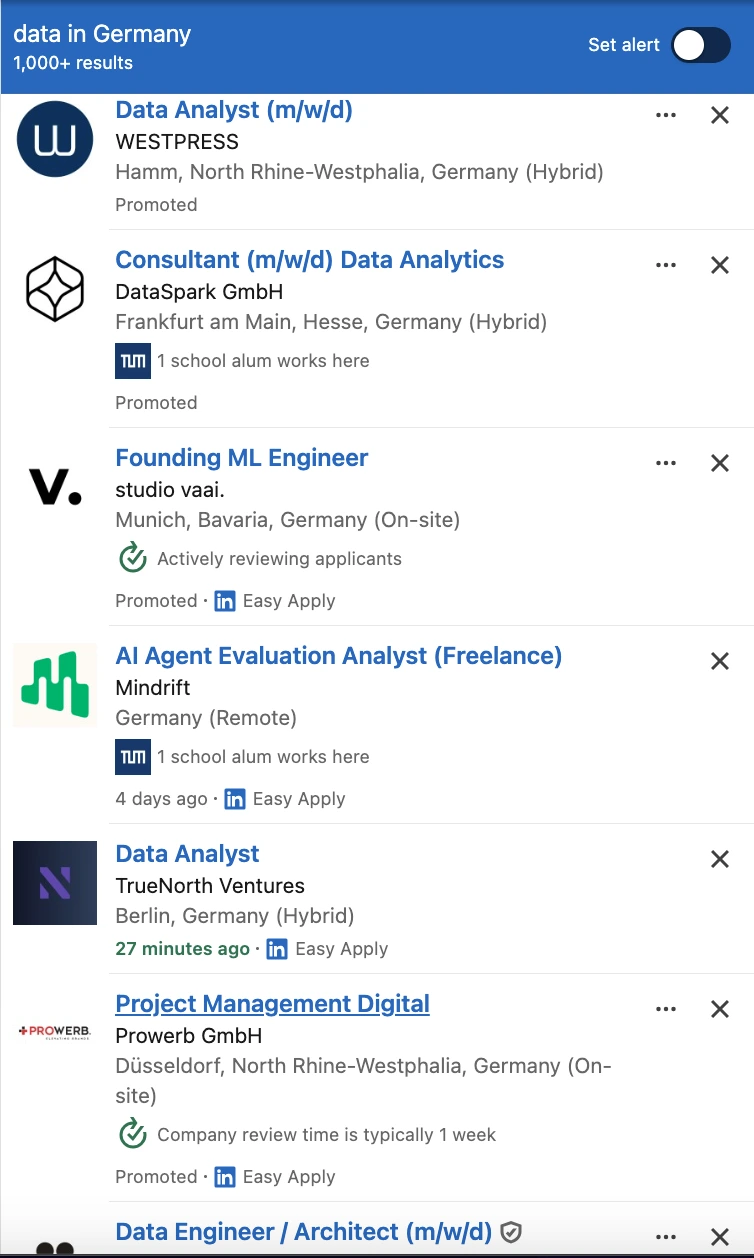
Now, this is not the pattern of a dying careers. This is the pattern of a transforming one!
So Why Does It Still Feel Hard to Land a Job?
Because accessibility changed the landscape. Thousands of new learners joined the field.
Courses, tutorials, certificates, and bootcamps made data skills widely available.
More jobs + many more applicants = higher signal-to-noise threshold.
The bar didn’t disappear… it simply moved, and that’s where AI becomes your advantage, not your threat.
The Reality: AI Is Becoming Part of the Modern Data Toolkit
Today’s data professionals who stand out are the ones who’ve learned how to:
- use AI to accelerate analysis
- automate repetitive work
- write and debug code faster
- ask sharper analytical questions
- and focus their energy on high-value thinking
AI is now:
- your coding assistant
- your productivity partner
- your second pair of analytical eyes
Data professionals who adopt these tools don’t get replaced, they get promoted.
If you are new to this, the good news is that these capabilities are learnable.
Positioning Yourself for the New Era of Data Work
Here’s the shift that matters:
AI won’t replace you, but someone who knows how to use AI will.
To thrive in this market, focus on four pillars:
1. Technical mastery but not perfectionism
-
- Excel, SQL, Python, statistics, dashboards
-
- Get comfortable, not encyclopaedic
2. Business understanding
-
- Know why a metric matters
-
- Know who it serves
-
- Know which decision it influences
3. AI As A Co-Pilot
-
- Use AI to be more effective
- Automate routine, mundane tasks
- Do NOT offload your thinking and human-skills
4. Personal Brand and Network
-
- Develop a brand that stands out
- Build your network and connections
- Trust and human connections matter more than ever before
These are the skills organizations hire for, and these are the skills that AI enhances, not replaces.
Final Thought: The Market Hasn’t Collapsed — It Has Evolved
Yes, the field is more competitive, Yes, AI is changing the workflow, but opportunities for data professionals have never been larger.
The question isn’t “Will AI take my job?” The real question is:
“Am I evolving with the industry, or standing still?”
If you choose the first path, you won’t just survive this shift… you’ll lead it.
Next Step Forward
If you want a clearer path to getting job ready, structured learning helps.
Whether you are building your first dashboard, sharpening SQL, or just trying to understand AI’s role in modern data teams, programs like Lumen’s 6-month Data Analytics, Data Science and AI/ML Engineering tracks give you depth, mentorship and portfolio you need to stand out… not just learn, but apply.
These programs were designed for this exact shift in the industry, to help learners grow the technical, analytical and communication skills that today’s data roles demand:
- Introduction to Data Analytics – Free 7-day short course to help you build your first data portfolio project.
- Data Analytics Program (6-month/12-months)
- Data Science Program (6-month/12-months)
- AI/ML Engineering Program (6-month/12-months)

Usaid Aamer
Content Writer for the Lumen Blog
Usaid is a data professional with a background in AI innovation and product strategy. He has contributed to teams at SAP BTP, SAP.iO, and Perplexity, working at the intersection of emerging technologies, business impact, and user-centered problem-solving. At Lumen, he writes to help learners navigate a rapidly evolving tech landscape and build the capabilities they need to grow, while connecting technical ideas with the real, day-to-day realities of modern digital work.
In his free time, Usaid shares his thoughts and photography on Instagram. His professional profile is available on LinkedIn.
Contact
Talk to us
Have questions? We’re here to help! Whether you’re curious to learn more, want guidance on applying, or need insights to make the right decision—reach out today and take the first step toward transforming your career.