

Over the past few years, organizations across industries have invested heavily in artificial intelligence. Budgets have grown, teams have expanded and experimentation has accelerated. Yet despite this momentum the outcomes remain unusually uneven.
While a fraction of organizations succeed in translating AI investments into measurable business impact, the majority struggle to move beyond pilots, proof of concept or internal showcases. Many initiatives stall, loose executive attention or are quietly “sunsetted”.
Industry research consistently shows that most AI initiatives struggle to deliver tangible returns. For example, surveys and analyst reports indicate up to 70 to 85% of AI projects never achieve expected business impact or progress beyond proof of concept, often due to lack of clear success criteria, poor data foundations and insufficient organizational alignment [Source: NTTData].
The critical question is no longer whether companies are investing in AI.
It’s why are so few turning that investment into sustained value?
The 5% Winners
What separates AI success stories from regrets is not better models, larger teams or greater enthusiasm.
According to a 2025 BCG group study, only around 5% of companies are currently generating significant, measurable value from their AI investments, despite widespread adoption and rising budgets. The gap between experimentation and impact remains wide [Source: Business Insider].
Organizations that succeed do not treat AI as an experimental playground. They treat it as a business transformation and consistently, three fundamentals determine the outcome.
1. Laser-Focused, Mission-Critical Use Cases
High Impact AI initiatives begin with clarity, not curiosity.

Successful organizations define, upfront which business problem truly matters, which metric they intend to influence and why AI is the appropriate lever at this moment in time. The goal is not to showcase innovation, but to move a meaningful needle.
By contrast, many initiatives fall into what is often called “innovation theatre” – visually impressive demonstrations, pilots and internal experiments that generate excitement but fail to change outcomes. These projects rarely survive leadership transitions or budget scrutiny because they are perceived as optional.
AI work that lasts is not “interesting to have”.
It is critical to the business agenda.
If priorities shift and an AI initiative no longer supports core objectives, it will be deprioritized regardless of technical sophistication.
2. Measurable Outcomes – Because Success is Not a Vibe
AI is often framed as fundamentally different from traditional software, particularly when it comes to measurement, while it is true that AI systems behave probabilistically rather than deterministically, this distinction does not eliminate the need for accountability.
Business metrics remain unchanged. Revenue growth, cost reduction, operational efficiency, speed and customer experience are still the benchmarks that matter. High-performing organizations define success before a project begins by answering difficult questions early:
- What does “done” look like?
- How will success be measured?
- At what point do we stop, pivot or scale?
Crucially, these organizations agree on KPIs in advance rather than retroactively justifying outcomes. If success cannot be measured, it cannot be defended and AI initiatives that cannot be defended rarely endure.
3. Executive Sponsorship is Non-Negotiable
Every AI initiative that creates lasting impact has active, sustained ownership at the executive level.
Executive sponsorship is not a ceremonial role, nor is it limited to approving budgets at the start of the project. It is the difference between AI being treated as a strategic capability or as an optional experiment.
When executive sponsorship weakens or disappears, even well-designed initiatives become vulnerable. Priorities shift. Budgets tighten. Leadership changes. In those moments, AI teams without clear C-level ownership are often perceived as isolated cost-centres rather than value drivers and isolated teams are the first to be questioned, deprioritized or removed.
Strong executive sponsors do three critical things:
- Anchor AI initiatives to business strategy
- Protect trams and momentum
- Translate AI outcomes into executive language
AI does not fail because models underperform in isolation. It fails when leadership disengages, when ownership becomes ambiguous and when no one at the top is accountable for turning capability into impact.
Beyond Strategy: Why Tech Still Breaks AI Initiatives
Even when strategic alignment and sponsorship exist, many AI projects stall during execution. In most cases, the bottleneck is not ambition or talent rather infrastructure or data.
Infrastructure: The Middle-Age Streets vs Modern-day Mass Transit Systems

Legacy systems were not designed for experimentation, iteration or scale. They resemble narrow city street built for carriages rather than modern transit systems designed for resilience and high-volume traffic.
High impact AI requires infrastructure that is:
- Scalable by design, not retrofitted
- Secure and ethical by default, not as an afterthought
- Interoperable across cloud, legacy and external systems
Patchwork architectures often perform adequately in controlled pilots but collapse under real world conditions, without a robust foundation even the most promising AI initiatives struggle to reach production.
Data: The True Bloodline of AI
No AI system can outperform the quality of the data that feeds it.
In practice, organizations spend a significant share of their AI effort managing data rather than building intelligence. The challenge is rarely a lack of data, but fragmentation.
Enterprise data is largely unstructured and distributed across documents, emails, audio, video, chat systems and operational platforms. When data is soiled, inaccessible or poorly governed the AI outputs become unreliable or misleading.
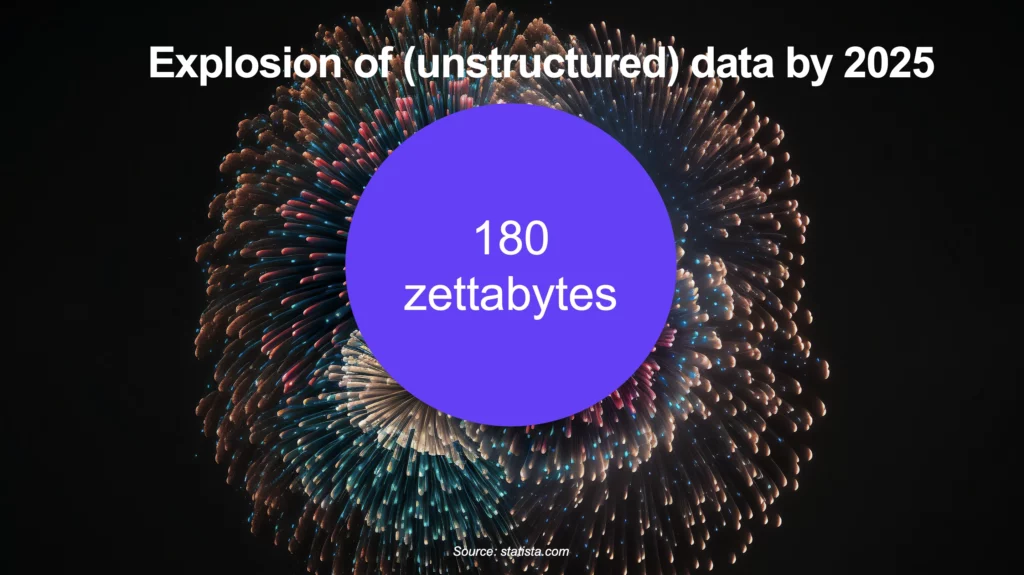
When data is unified without forcing “artificial standardization” the AI shifts from a liability to an advantage. There are no shortcuts here, good AI depends on good data that is consistently accessible where it lives.
The Real Barrier No One Likes to Talk About: Humans
Technology alone explains only a fraction of AI failures. The larger barrier is human.

Leaders may be enthusiastic about AI without fully understanding its limitations. Teams may feel overwhelmed by the pact of change. Fear of irrelevance, replacement or falling behind quietly undermines adoption.
When leaders cannot speak the language of AI, trust erodes.
When teams do not feel supported, progress slows.
AI transformation is not purely technical. It is cultural.
Upskilling, psychological safety and mindset shifts are as critical as models, pipelines and platforms. Organizations that invest only in tools without investing in people rarely succeed.
AI Transformation is a Leadership Story
After decades of progress, one lesson stands out clearly:
AI transformation is not a technology story. It is a leadership story.
The organizations that succeed act deliberately. They define priorities with precision, invest with intent, build durable foundations and bring their people with them.
Despite mixed results so far, organizations are not stepping back from AI. A 2025 survey of global CEOs found that nearly 70% plan to increase AI investment, even though fewer than half of existing initiatives have produced returns exceeding their cost [Source: Wall Street Journal].
The message is clear: AI spending will continue, but tolerance for low-impact initiatives will not.
Final Thoughts
AI transformation should be treated like a critical operation, not a hackathon.
- Plan carefully.
- Choose the right use cases.
- Define success clearly.
- Build the right technical and data foundations.
- Support the people driving the change.
Because soon, “doing AI” will not be impressive. It will be expected.
The only question that will matter is whether your organization is creating real impact or simply generating hype.
Next Step Forward
This blog is an excerpt of Dr. Humera’s opening keynote at AI Nordics 2025, where she spoke about AI in Business: How to separate hype from high impact. Watch the keynote here.
If you want to learn, how to carry out AI transformation in your organization, drop us a note below.

Usaid Aamer
Content Writer for the Lumen Blog
Usaid is a data professional with a background in AI innovation and product strategy. He has contributed to teams at SAP BTP, SAP.iO, and Perplexity, working at the intersection of emerging technologies, business impact, and user-centered problem-solving. At Lumen, he writes to help learners navigate a rapidly evolving tech landscape and build the capabilities they need to grow, while connecting technical ideas with the real, day-to-day realities of modern digital work.
In his free time, Usaid shares his thoughts and photography on Instagram. His professional profile is available on LinkedIn.